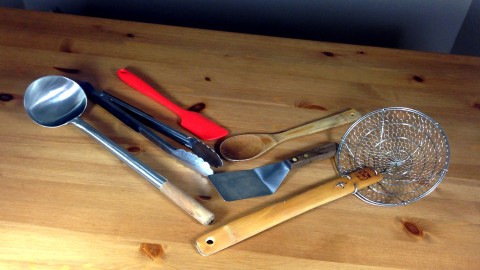
Using your dinner silverware to stir, flip, and turn your food while it cooks will only get you so far. Best to get a set of kitchen utensils instead.
While getting the best cooking utensils isn’t as important as getting the right cookware and knife, you can still do better than a flimsy plastic set.
Fortunately, beginners will only need six utensils.
A Wooden Spoon
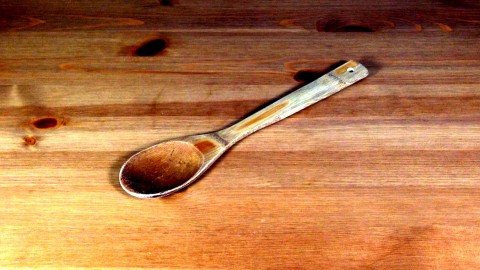
Perhaps the most iconic utensil in your kitchen, a wooden spoon is ideal for stirring up big batches of cooking stews and soups.
Wood is a poor conductor of heat, so you don’t have to worry about burning yourself. Wood is soft enough that you don’t have to worry about scratching your cookware. And it just feels damn good in your hand.
I really can’t give any good specific recommendations here. Wooden spoons are so basic, old, and cheap that I really can’t tell the difference. Just get one and move on.
I have a set of bamboo spoons I got off Amazon, and get a lot of mileage out of them.
A Metal Spatula
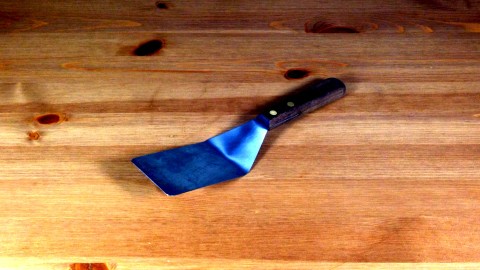
From asparagus to pancakes, if you’re frying anything in your pan you need a spatula to move things around. Specifically, a turner, which is ideal for scraping the flat bottom of your pan.
If you use a cast-iron skillet, you need a metal turner.
Not only will the strong blade allow you to get every last bit of food off the pan, but it actually smooths out the surface of the pan in the meantime, improving its nonstick properties.
I use a Dexter-Russell walnut pancake turner, and highly recommend it.
A Silicone Spatula
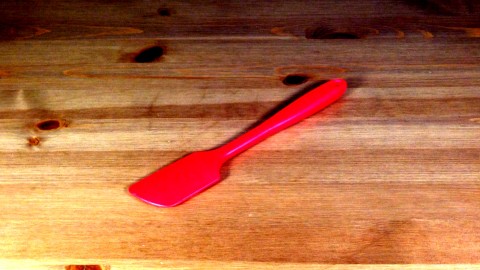
Wooden spoons are excellent for stirring large pots of food cooking low and slow, but they can fall short when you are using a saucepan and/or high heat and need to get into every nook and cranny of a pot to prevent burning and get every last bit of food off.
I use a silicone spatula for cooking rice and sauces in my saucepan, where it’s essential.
Any old silicone spatula will do here, but the best one on the market is the GIR Ultimate Spatula. It’s strong yet flexible, ergonomic, and doesn’t have any nooks where food can get stuck.
A Slotted Spoon
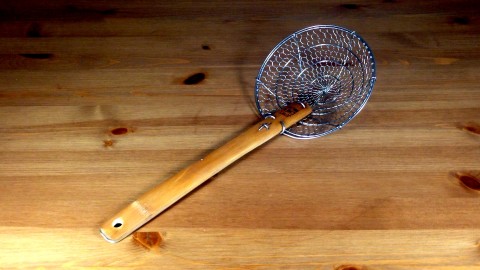
Sometimes you cook food in a liquid, then want to get it out.
For beginning cooks, you’ll run into this problem most often with braises such as pot roasts, where you’ll want to remove the meat and veggies to reduce the cooking broth down to a gravy.
In these cases, you’ll need a slotted spoon.
Now, in most cases you’ll find medium-sized plastic or wooden spoons with a few slits or holes in ’em.
In a pinch, these will do the job, but you can do sooooooooo much better if you upgrade to a spider skimmer.
Spiders are essentially massive slotted spoons made of wire and originally used to fish out deep-fried food out of woks. But there’s no reason you can’t use it for things you are cooking in your Dutch oven as well.
I use this spider skimmer and highly recommend it, since it will pay for itself in time saved. But there’s also a slotted spoon in the wooden spoon set I recommend if you aren’t ready to plop down for the real deal just yet.
A Pair of Tongs
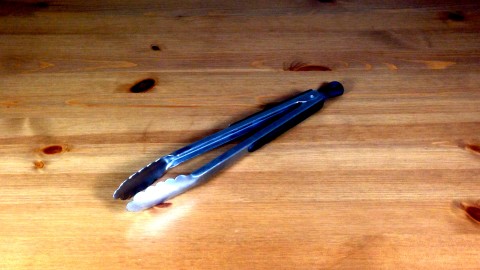
Flipping meat on a blazing-hot skillet with a spatula is asking for a grease fire.
The inability to easily and gently move food around with a spatula without splattering grease everywhere (or missing your mark altogether) is enough of a reason to get a pair of tongs.
But wait, there’s more!
Tongs are great for mixing up bowls of salad or sauced vegetables without breaking them up, and they can also be a godsend for reaching those G-D jars on the top shelf you can’t quite reach.
Cheap tongs abound, so grab one if you don’t have one. Otherwise, the Cadillac of tongs is the 12″ Oxo Good Grips, which I’m a big fan of.
A Ladle
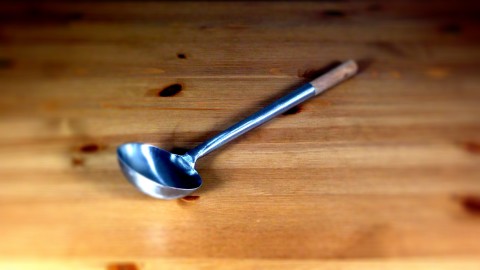
The final utensil you’ll need is a ladle, which is critical for all the soups, stews, and braises you’ll be making in your Dutch oven.
Like most of my recommended utensils, cheap plastic ones can be found everywhere, and you likely already have one.
For those of you looking to upgrade, I’d again suggest you get another wok accessory.
Wok ladles are easier to maneuver than the big aluminum beasts you’ll find hanging in restaurant kitchens, and the wooden handles feel oh-so-much-better.
Plus, if you’re going to get a wok one day (which are a good intermediate piece of cookware, and useful for far more than just stir-frys), you’ll need one of these as well.
I have this wok ladle and spatula set, and also use the long spatula for grilling, so that’s a selling point too.
Okay, now you’ve got your cookware, knife, and utensils. Ready to rock right?
Sure, but there’s a few more miscellaneous pieces of gear that will make your life far easier.
More on those in the next article!
{ Comments on this entry are closed }
 I'm a science geek, food lover, and wannabe surfer.